
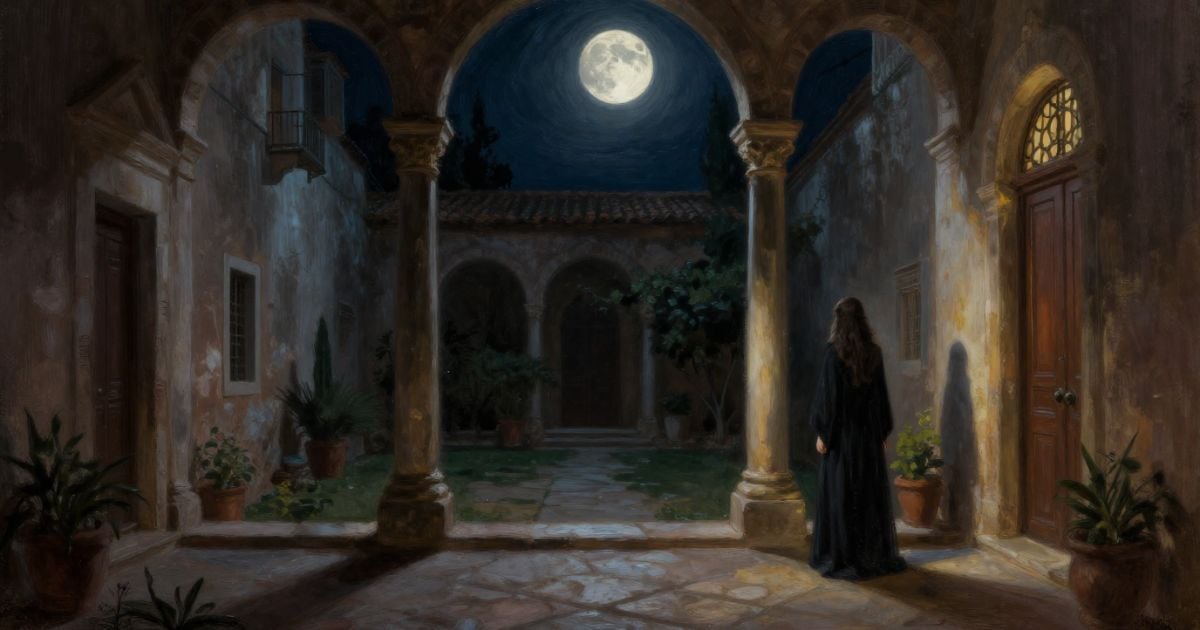
Julia's wedding day arrives with processions, gifts, and guests assembled to witness a bargain she never accepted. The marquis goes to lead her to the chapel and finds her barred chamber empty, bridal clothes abandoned, and a farewell letter to Emilia declaring flight from a fate worse than unknown danger. The duke is publicly humiliated before the very nobles invited to celebrate his triumph; the marquis interrogates Robert, whose keys should have made escape impossible, and imprisons him on suspicion while search parties scatter across Sicily. Even Emilia falls under watch as the marchioness accuses Madame de Menon of complicity.
The household tries to regain control of the narrative before gossip solidifies into ridicule. Servants again report lights in the south tower and a figure carrying a lamp along the outer walls; the marquis, furious at being mocked, leads a midnight procession through the abandoned wing to prove there is nothing to fear. The tour finds only decay, fallen stone, and rooms too ruined to inhabit, yet the performance cannot erase Julia's absence or quiet the staff who remember Vincent's dying face. Superstition and authority keep colliding because both depend on the same sealed doors.
The duke and marquis nearly duel over the deception, then agree to pursue Julia with united force and marry her without delay if she is found. Weeks of search fail while Ferdinand rejoices and grieves in the dungeon, unable to help. Intelligence finally moves the hunt outward. A spy reports Julia hiding in the forest of Marentino with a young cavalier, sending the duke on a wild pursuit through storms and bandit country while Ferdinand remains in the dungeon and Emilia watches helplessly at Mazzini. His certainty makes every landscape an extension of his entitlement. He mistakes monks feasting for midnight prayer and later attacks a young couple by a moonlit lake, certain he has cornered Julia. The woman is another noble daughter fleeing a convent marriage; the duke's rage collapses into fever when he realizes his violence pursued the wrong story.
In a robber cave he discovers a final domestic twist: the outlaw chief is his own estranged son Riccardo, exiled years earlier for a crime the duke's pride refused to forgive. Father and son confront each other as enemies because the duke could not tolerate disobedience at home. The duke must return to the marquis empty-handed while Julia's refuge with peasants remains unknown to him. The chapter therefore ends with two pursuits unresolved. Julia remains free but hunted, and the duke rides after a phantom family reunion while the castle still cannot explain its lights. Radcliffe pairs Julia's escape with Riccardo's banishment to show how patriarchal houses produce both runaway daughters and outlaw sons, each punished for refusing an arranged fate.
Radcliffe wrote this in 1790 when daughters were literally property, but the emotional pattern remains unchanged. Julia's father believes he's protecting her by arranging a marriage that ensures financial security. The Duke believes he's offering her status and comfort. Neither man can comprehend that security without choice isn't security—it's captivity with better food. This dynamic plays out constantly in working-class families today. Parents who've struggled financially often push their children toward 'safe' choices: marry the stable guy, take the government job, don't risk everything on dreams. The intention is love, but the execution can become control. The child feels ungrateful for rejecting what their parents sacrificed to provide. The parents feel betrayed when their careful planning gets thrown away for uncertainty. Both sides are right, and both are wrong. The real tragedy isn't that Julia runs away—it's that the situation escalated to where running away became the only option for maintaining dignity. Healthy families find ways to honor both security and autonomy. They create space for young people to make their own mistakes while still providing support. When that balance fails, you get the pattern Radcliffe identified: control tightens, resistance builds, someone snaps toward freedom regardless of consequences. The question becomes: how do we recognize this pattern early enough to prevent the explosion?
Explore this chapter with AI to uncover deeper meaning and practical takeaways.
AI Discussion