
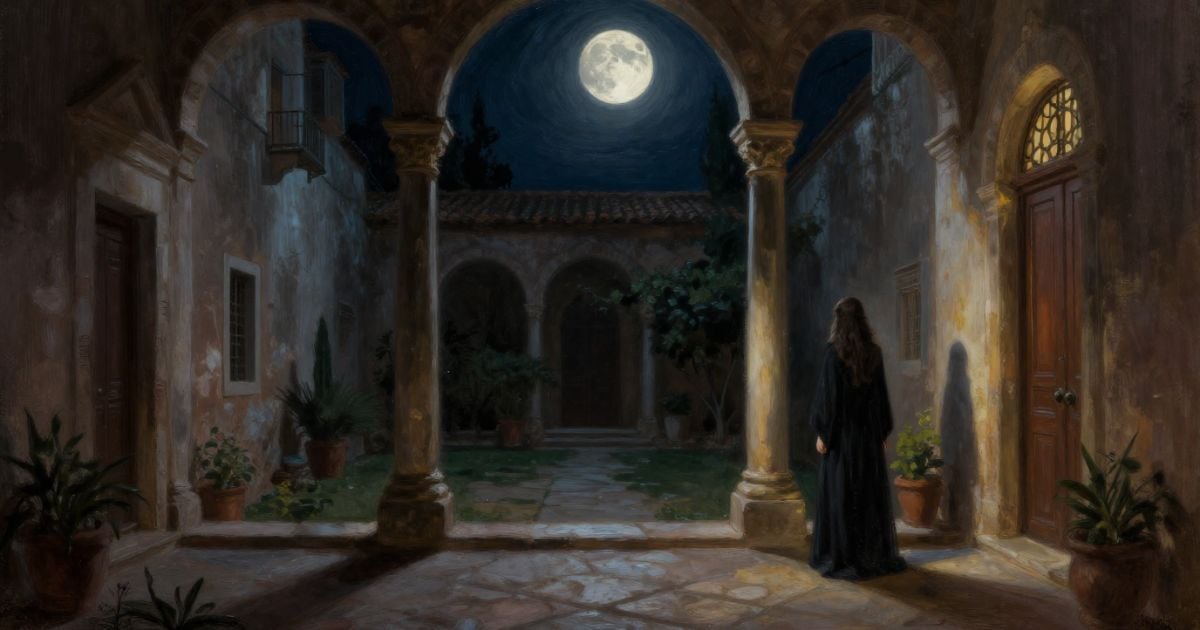
Ferdinand learns the southern dungeon and his mother's cell connect through passages the marquis used to stage hauntings and hide imprisonment. Maps he drew as a curious boy suddenly explain adult crimes: how lights and groans were staged, and how a living wife could be erased into folklore. He searches the empty southern cell after the marquis's death and finds only the proof that Julia and her mother were moved elsewhere. Emilia, recovering from illness brought on by the castle's horrors, can tell him little except that the household has been living inside a lie.
Still fearing Julia remains with bandits, he rides through storm toward Palermo and the forest of Marentino, carrying guilt for Hippolitus's wound and hope that one sibling might still be alive. Every mile without news feels like confirmation that the marquis's cruelty has outlasted his victims. When the lighthouse flame finally appears above the rocks, Ferdinand rides toward it not knowing whether he will find survivors or another sealed door. At a lighthouse he reunites with Julia, Hippolitus, and the living marchioness, whose escape Hippolitus accomplished through the cavern once mother and daughter were separated again. The family gathers the proof needed to end the marquis's reign of lies just as the marquis himself dies by poison downstairs, his second wife having turned his own murder plot against him. News travels unevenly: some servants flee, others weep, and Emilia begins to understand how much of her childhood was built over a living grave.
Restoration follows retribution rather than replacing it. The marchioness survives to reclaim her name, Julia and Hippolitus marry, Madame de Menon is honored, Ferdinand inherits with cleaner hands, and Mazzini is abandoned to the silence it earned. Emilia, who grew up beside a living grave she never knew, must rebuild trust in a family that lied for fifteen years. The castle that once terrified them is left empty on purpose. Radcliffe closes by rewarding perseverance rather than innocence. The virtuous endure long enough for architecture, law, and false ghost stories to fail together, but the final tone is relief edged with exhaustion, not fairy-tale forgetfulness.
Radcliffe understood something profound about power: those who control resources often manufacture dangers to protect their control. The marquis didn't just imprison his wife - he built an entire mythology around the southern buildings, spreading ghost stories that were more effective than locks. This pattern transcends centuries because fear is cheaper than security and more reliable than force. In our time, we see this everywhere in working-class life. Employers who create artificial urgency to prevent workers from questioning safety violations or wage theft. Healthcare systems that manufacture fears about 'difficult' patients to discourage advocacy. Family members who create drama about 'outsiders' to prevent relatives from getting perspective on toxic dynamics. The mechanism is always the same: create a scary story, repeat it until it becomes accepted truth, then use that manufactured fear to control behavior. What makes this particularly insidious is how it turns our protective instincts against us. We avoid the 'haunted' building, the 'risky' conversation, the 'dangerous' investigation - not knowing we're protecting someone else's crime. The key is learning to distinguish between real warnings and manufactured ones. Real dangers have evidence and specifics. Manufactured ones rely on repetition, emotion, and keeping you from looking too closely. When someone benefits from your fear, that's usually a sign the fear is serving their interests, not your safety.
Explore this chapter with AI to uncover deeper meaning and practical takeaways.
AI Discussion