
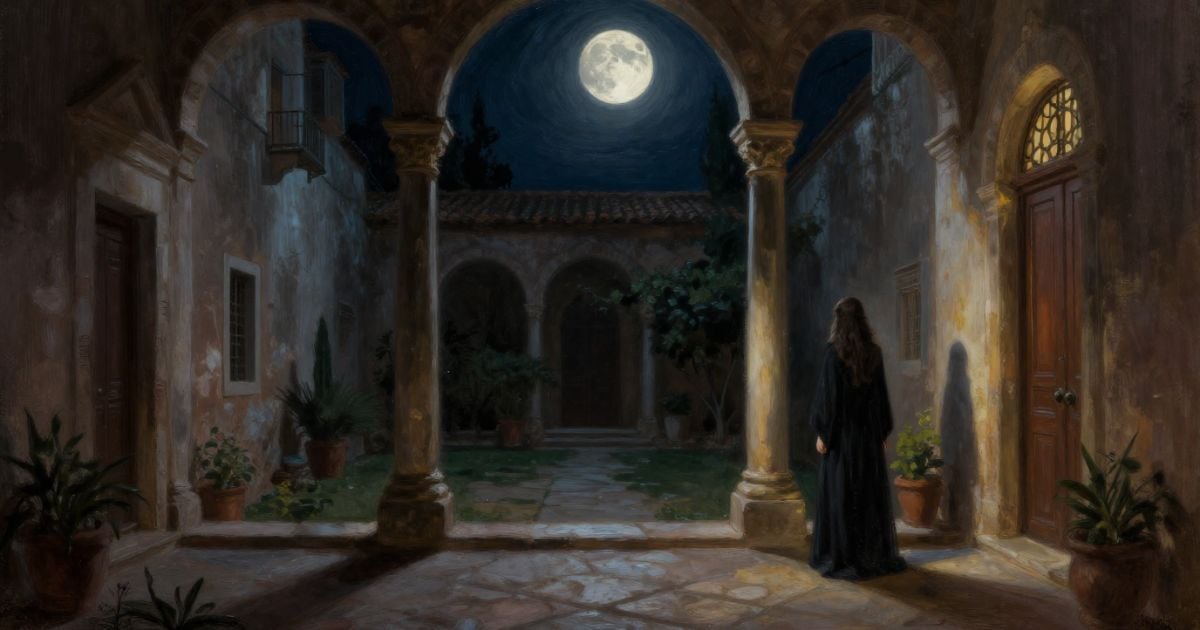
Recovered in Calabria, Hippolitus learns Julia fled St. Augustin and rides into Sicily alone through unfamiliar passes until storm and exhaustion disorient him. He asks peasants and monks for news, receives only rumor, and presses on until the ruined monastery appears above a desolate ridge. He stumbles on a ruined monastery used by bandits, enters despite terror, witnesses murder in a torchlit hall, and flees into underground passages where the castle's geography of secrecy repeats in outlaw form. Torches flare on weapons and stolen silks; Hippolitus hides behind fallen masonry until a footstep forces him deeper into the vaults. The banditti are not romantic rebels but men who traffic in fear, stolen goods, and captive women.
There he finds Julia captive among plundered finery and kills her assailant in combat when the man seizes her again. Hippolitus is wounded in the struggle but does not retreat. The victory is immediate and sickening: blood on stone, Julia trembling, and no clear exit aboveground. They are trapped in a corpse-filled vault with the dead man's companions pounding at the door until officers of justice raid the stronghold at last, responding to crimes the duke's earlier pursuit helped expose. Shots echo through stone; bandits scatter; Hippolitus pulls Julia through smoke and falling timbers. In the chaos they escape through a cave into the forest while Ferdinand's fate remains unknown.
The reunion is accident, not ceremony. Salvation arrives with corpses, confusion, and separated siblings. Julia is alive, but the duke's patrols still scour the roads and Ferdinand's absence keeps the family's ledger open. Hippolitus hides Julia in a peasant village with only a few trusted hosts, then rides on alone toward Mazzini through country still full of the duke's patrols. He leaves her with bread, a disguise, and the promise to return once her brother's fate is known. Until then she must trust strangers and stay silent if patrols come asking questions. He knows partial rescue is the only kind this novel has offered so far. Radcliffe refuses a tidy deliverance because Gothic virtue is proven by endurance after violence, not by a single sword stroke.
Radcliffe understood something profound about human nature: we often discover our greatest strength in our most terrifying moments, but only when the stakes involve someone we love. Hippolitus spends the entire novel being cautious, calculating risks, trying to stay safe. But the instant he sees Julia threatened, all that careful self-preservation vanishes. He becomes a different person—not because he's suddenly fearless, but because his fear has a new target. He's no longer afraid for himself; he's afraid for her. This shift in focus creates a kind of superpower. The same mechanism operates today. The soft-spoken single mother who becomes a force of nature when her child's teacher dismisses their learning disability. The gentle grandfather who finds his voice when he sees his grandson being bullied. The quiet coworker who finally stands up to workplace harassment when they witness it happening to someone else. Fear doesn't disappear in these moments—it transforms. Instead of paralyzing us, it fuels us. The key insight is recognizing that this protective instinct reveals our deepest values. Who would you protect without hesitation? What would you defend at any cost? These answers map your moral compass more accurately than any abstract principle. And here's the strategic advantage: once you identify what triggers your protective courage, you can extend that same fierce advocacy to yourself.
Explore this chapter with AI to uncover deeper meaning and practical takeaways.
AI Discussion