
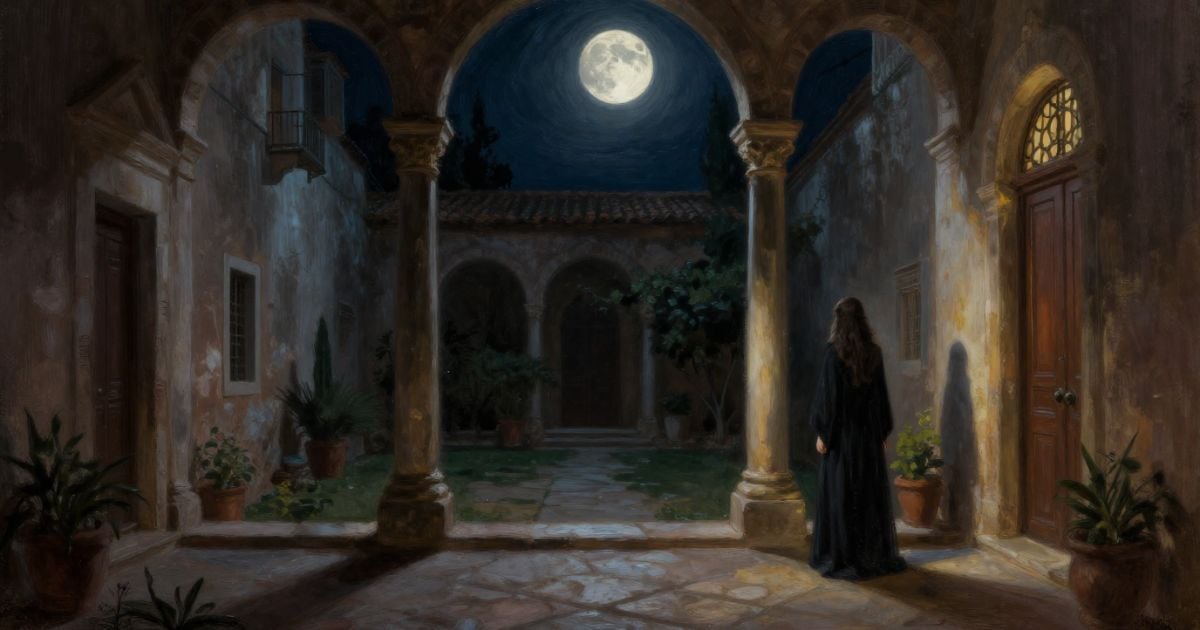
The Mazzini castle at the close of the sixteenth century looks noble and sealed, but its real government is neglect. Marquis Ferdinand is voluptuous, imperious, and indifferent to fatherhood; after Louisa Bernini dies young, possibly from his cruelty, he remarries Maria de Vellorno and retreats to Naples with his son, leaving Emilia and Julia to Madame de Menon. The girls grow accomplished in music and drawing inside apartments that feel larger than the household can fill. Corridors echo, inner courts stay silent, and the southern wing has stood shut so long that rust and rumor have merged.
Superstition becomes household policy when servants see lights moving through windows that should be abandoned. Madame de Menon reports the sighting and orders keys searched; Vincent the steward dies after trying to confess a secret tied to those rooms, but death silences him before he can name what the marquis hides. His last hours frighten the servants more than any ghost because they suggest complicity, not fantasy. Robert inherits Vincent's keys and repeats the reports, which only deepens the marquis's contempt for anyone who questions his authority. When the marquis returns alone from Naples, he laughs away the supernatural story, rebukes Robert for repeating it, and treats female testimony as hysteria.
The visit nonetheless changes the castle's future. Ferdinand the younger son is still away when his father announces a grand festival for the heir's coming of age, promising music, guests, and society Julia has never been allowed to enter. The marchioness arrives with a glittering train; gates open, halls brighten, and for the first time Julia tastes the possibility of a world beyond confinement. Emilia shares the wonder cautiously while Madame watches the marchioness with distrust.
Julia also sees the marquis's temper at close range: he is gloomy with his daughters, impatient with fear, and quick to punish servants who speak. Yet the chapter ends with festivity winning the foreground. Julia's imagination inflames; musicians play; the household performs loyalty. Radcliffe sets the Gothic contract in that contrast: beauty and spectacle will not cancel what the sealed wing keeps hidden, and the man who controls the keys refuses to use them.
Radcliffe wrote this in 1790, but she understood something timeless: children need consistent, caring adults, and if parents won't provide that, someone else must step up or the kids suffer. The Marquis Ferdinand has all the legal power over his daughters, but he's emotionally absent, leaving them vulnerable to his manipulative wife. Their salvation comes from Madame de Menon, who has no official authority but provides the daily care that actually shapes their character. This pattern repeats constantly today. Single mothers working multiple jobs rely on grandmothers to provide stability. Overwhelmed parents lean on teachers, coaches, or neighbors to mentor their kids. In toxic households, older siblings become surrogate parents. The question isn't whether this should happen - it's inevitable. The question is who fills those gaps and what their motivations are. Some people, like Madame de Menon, step up out of genuine love and create safe spaces for growth. Others exploit the vacuum for their own purposes, like the stepmother who isolates the girls to maintain control. The most dangerous situation is when no one steps up at all, leaving children to raise themselves. Understanding this pattern helps us recognize both the heroes and the predators in any family system, and make conscious choices about when and how to provide the care that missing parents should have given.
Explore this chapter with AI to uncover deeper meaning and practical takeaways.
AI Discussion